A Primer on Intergenerational Trauma
While I like to draw the line between human resilience and more global and universal resilience, I am going to focus on the human side of this discussion today.
This discussion is not science fiction or any other kind of fiction. It is a fully developed evidence-based scientific theory that sounds a lot like the old wives’ tales about how the things your mama experienced before you were born determine the way you approach the world. Example – if your mama was scared by an angry, barking dog who chased her up the street while she was pregnant – you might grow up to be a lion-tamer or a police officer.
It turns out, the Crazy Old Lady Society had it kind of right.
In this post, I am taking a deep dive into a recently published study that incorporates most of the compiled information about the science, history and biology that supports the theory that your mother’s trauma will alter the part of your DNA that guides how you approach life.
El-Khalil et al. BMC Psychology (2025) 13:668
https://doi.org/10.1186/s40359-025-03012-4
Waxing a bit less poetic, and simply put – trauma permanently alters the part of the brain that deals with trauma in a way that is transmittable via DNA.
Every person faces injury, pain, and traumatic circumstances. Some injuries will heal rapidly, and some will leave permanent damage. If the pain is extreme, the injuries will be extensive and the impact significant. Some is severe enough to change how progeny develop. We recognize that physical injury from poison or other forces could impair or alter genetic structures- but it turns out that internal bodily response to trauma of all kinds, emotional or physical, is just as destructive. That doesn’t mean that every person who experiences deep pain will be deeply and irrevocably flawed, unable to reach their full potential for creativity, happiness, and productivity, and their offspring will be robbed of a full and satisfying life.
We merely need to recognize as the progenitors of the following generation, what we experience has far reaching implications for the next iteration.
We may not realistically build a society that prevents the world’s most severe injustice from befalling any one soul – but we can build a foundation for our own lives rooted in the likelihood of injury and pain and design life ladders that allow us and our children to climb out of the dark pits of despair we may fall into from time to time. We can teach the broad public about the impact of trauma on human functioning and social wellbeing, and remove barriers of shame in naming and treating it. We can normalize the need for significant trauma recovery in impacted communities, incorporate trauma recovery practices into daily routines, and teach child rearing strategies that instill resilience and promote healing.
1. Understanding the Echo: What is Intergenerational Collective Trauma?
In developing tools for trauma recovery and enhancing the resiliency in our social and environmental systems to provide the foundation for recovery, it is essential to understand that trauma is not merely an event that happens in the past; it is a physiological legacy that can be inherited. Intergenerational trauma occurs when the psychological and physiological effects of a traumatic experience are transmitted from survivors to their descendants. To grasp the nuances, breadth, and longterm implications of this concept, we should distinguish between individual experiences and the massive, shared experiences known as collective trauma.
| Feature | Individual Trauma | Collective Trauma |
| Scope | Affects a single person and their immediate circle. | Affects an entire group, community, or nation. |
| Origin | Arises from personal events like accidents, assaults, or isolated family violence. | Arises from shared events like war, genocide, natural disasters, or systemic oppression. |
| Social Impact | Linked to the personal history and specific circumstances of one individual. | Shapes cultural identity, alters social norms, and impacts collective memory across generations. |
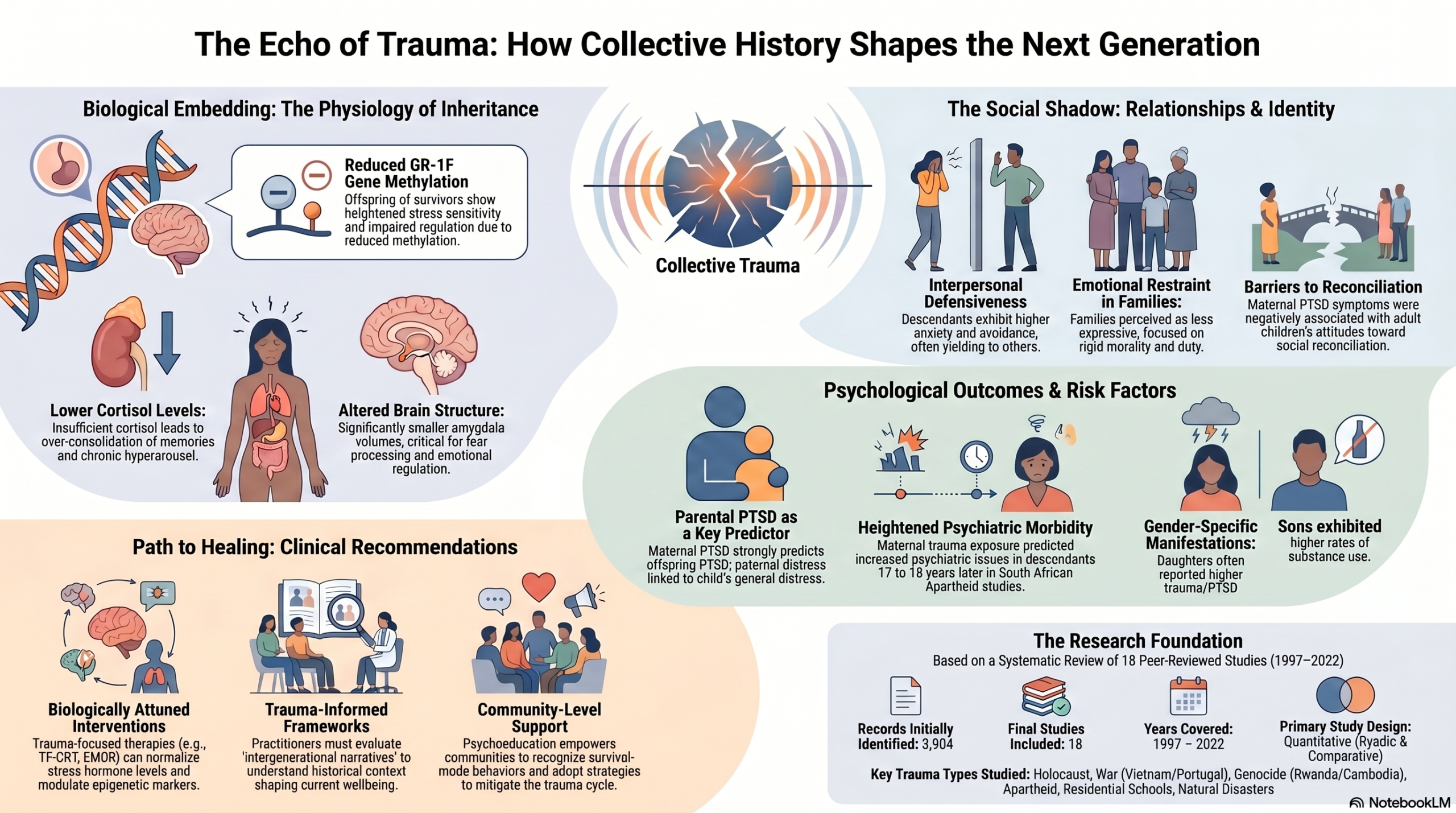
A 2025 systematic review of 18 quantitative studies reveals that while these collective events may conclude, they leave a physical “blueprint” that is passed down to the next generation, influencing their biological baseline for stress.
——————————————————————————–
2. The Molecular Switch: Epigenetics and the GR-1F Gene
The mechanism behind this transmission is biological embedding through epigenetics—chemical modifications that dictate gene expression without altering the DNA sequence. A landmark study by Yehuda et al. (N=80) focused on the GR-1F gene (the Glucocorticoid receptor gene), which is the primary regulator of our stress response.
The review highlights a specific “molecular switch”: the methylation of the promoter region of the GR-1F gene. In offspring of Holocaust survivors, researchers found significantly reduced methylation. Mechanistically, reduced methylation of this promoter region leads to the increased expression of glucocorticoid receptors. This creates an ultra-sensitive negative feedback loop that essentially “shuts down” the body’s ability to maintain healthy cortisol levels during stress.
The Chain of Impact:
- The Parental Experience: Parental PTSD—where maternal PTSD acts as a critical moderator. The lowest methylation levels (highest risk) are found in offspring where both parents suffer from PTSD.
- The Epigenetic Change: Reduced GR-1F methylation in the descendant.
- The Biological Consequence: Increased glucocorticoid receptor sensitivity, leading to an over-active feedback loop that suppresses cortisol production.
This molecular shift ensures that the offspring’s “stress thermostat” is set to a higher sensitivity before they ever encounter a stressor themselves.
——————————————————————————–
3. The Stress Thermostat: Hypocortisolism and the HPA Axis
In neurobiology, we often assume high stress equals high cortisol. However, intergenerational trauma often manifests as hypocortisolism—chronically low cortisol levels. This occurs because the HPA axis (Hypothalamic Pituitary Adrenal axis) becomes so sensitive that it over-regulates, suppressing the very hormone needed to manage the stress response.
Bader et al. (N=69) discovered that developmental timing is a major predictor: offspring of mothers exposed to the Holocaust as adults exhibited the lowest cortisol levels and the highest levels of PTSD symptoms.
Low cortisol is a significant risk factor for PTSD because an insufficient cortisol response fails to “contain” the body’s alarm system. This failure leads to the over-consolidation of traumatic memories, where the brain encodes fear-based memories more intensely, making them harder to extinguish and increasing the risk of psychopathology.
These chemical signals do not exist in a vacuum; they eventually reshape the physical architecture of the brain.
——————————————————————————–
4. Mapping the Traumatized Brain: Amygdala and Hippocampus Volume
Neuroimaging provides a window into the structural legacy of trauma. Sarigedik et al. (N=40) utilized structural imaging to compare descendants of earthquake survivors to a control group, finding profound differences in the regions responsible for threat detection and memory.
| Brain Region | Function | Findings in Trauma-Exposed Descendants | Hemispheric & Timing Nuances |
| Amygdala | Threat detection; emotional fear-processing. | Smaller Bilateral Amygdala Volumes.Linked to impaired emotional regulation and hyperarousal. | Mothers exposed during adolescence had offspring with larger left amygdala volumes relative to the right. |
| Hippocampus | Memory consolidation and learning. | No significant overall volume difference across the total trauma group. | Adolescent maternal exposure resulted in larger left hippocampal volumes compared to the right. |
These findings suggest that the timing of a parent’s trauma (e.g., adolescence vs. adulthood) creates specific hemispheric asymmetries in the descendant’s brain. While the amygdala is generally smaller—suggesting a “wear and tear” or developmental stunting—the shift in volume toward the left hemisphere in specific developmental windows points to a complex, inherited adaptation to threat.
——————————————————————————–
5. From Biology to Behavior: Psychological and Social Manifestations
The synthesis of 18 reviewed quantitative studies confirms that biological markers translate into specific psychological profiles. Across these studies, the 3 Most Common Psychological Markers in second-generation descendants are anxiety, depressive symptoms, and secondary traumatization.
The review identifies maternal PTSD as the consistently stronger, independent predictor of these outcomes. This biological and psychological inheritance manifests in unique social behaviors:
- Interpersonal Dynamics: Descendants often exhibit “Relational Restraint,” characterized by an avoidance of conflict, submissiveness in competitive environments, and a generalized mistrust of others.
- Social Identity: Research by Sorcher & Cohen highlights a heightened sense of group loyalty and an increase in trauma-related imagery (intrusive thoughts or dreams regarding the historical event).
- Relational Restraint and Idealization: In studies by Gangi et al., descendants described their actual families as less emotionally expressive and more focused on rigid moral/religious values. Interestingly, these descendants described their ideal families as being more oriented toward challenges and competition, revealing a deep-seated desire to break free from the “survival mode” of their upbringing.
——————————————————————————–
6. Breaking the Cycle: Synthesis of Resilience and Intervention
The presence of these biological and psychological marks is not a life sentence. As a curriculum designer, the “So What?” of this research is the promise of biologically attuned interventions.
We now understand that interventions like Trauma-Focused CBT and EMDR are effective because they do more than process memories—they have the potential to normalize the HPA axis and even reverse epigenetic marks. By addressing the physiological “echo” of the past, we can help descendants regulate their stress response and move toward a state of resilience.
Learner’s Checklist: 3 Takeaways for Addressing Trauma
- Biological Awareness: Recognize that stress sensitivity (hypocortisolism) can be an inherited trait. Understanding that a “smaller amygdala” or “low cortisol” are physical markers of survival history can reduce the stigma of mental health symptoms.
- Maternal Influence & Timing: Clinical assessments must prioritize the mother’s history, specifically her age at the time of exposure, as this serves as a primary predictor for the descendant’s neurobiological profile.
- Early Screening: We must advocate for early screening of biological stress sensitivity in high-risk populations to provide support before clinical disorders develop, utilizing the cultural and historical context as a roadmap for healing.
By understanding the neurobiology of the “echo,” we move from viewing descendants as “damaged” to seeing them as individuals with a highly specialized, inherited survival system that can be recalibrated for a safe and stable world.